
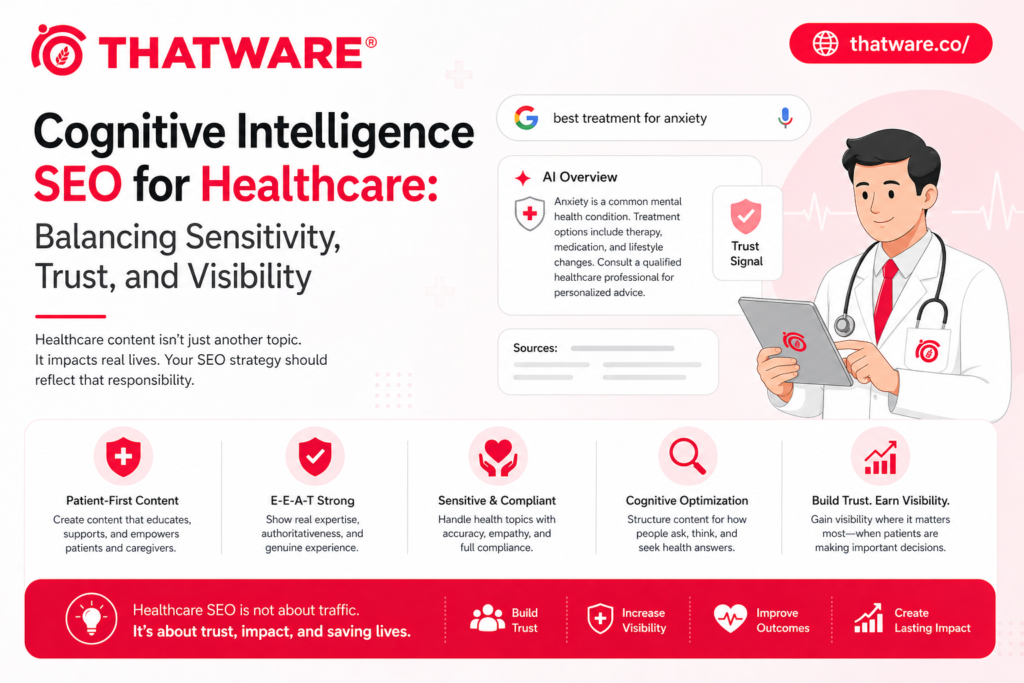
Healthcare SEO is a different animal. The stakes are different — someone searching for medical information is often scared, confused, or making decisions that affect their health and sometimes their life. The regulatory context is different — what a healthcare brand can say, how it can say it, and what it must not imply are all constrained in ways that most SEO content isn’t. And Google’s standards are different — healthcare content sits squarely in YMYL (Your Money Your Life) territory, where the bar for expertise and trustworthiness is explicitly higher.
Cognitive intelligence SEO for healthcare has to hold all of these considerations simultaneously. Visibility matters — people who need healthcare services need to find them. Sensitivity matters — content that doesn’t account for the emotional and psychological state of the reader can cause real harm. Trust matters — medical authority signals are evaluated more stringently than in almost any other category. Getting any one of these wrong undermines the others.
The YMYL Stakes and What They Actually Mean
Google’s YMYL category designation for healthcare content isn’t just a label — it has concrete implications for how content is evaluated and ranked. Health and medical content is assessed against higher expertise, authoritativeness, and trustworthiness standards than general informational content. The same E-E-A-T signals that matter everywhere matter more in healthcare.
Practically, this means several things that shape healthcare SEO strategy. Author credentials matter explicitly — content attributed to or reviewed by licensed healthcare professionals, with verifiable credentials displayed prominently, outperforms similar content without those attributions. Sourcing matters — claims backed by peer-reviewed research or authoritative medical guidelines are weighted differently from unsourced assertions. Accuracy and currency matter — outdated medical information is treated as a trust signal failure, which means content maintenance is an ongoing obligation, not a post-publication afterthought.
None of this is new — healthcare marketers have known about YMYL constraints for years. The cognitive intelligence layer adds something: it asks not just “is this content trustworthy?” but “is this content built with genuine understanding of how healthcare searchers think and what they need?” Those are different questions, and the second one is often the missing piece.
Understanding the Healthcare Searcher’s Cognitive State
Someone searching for healthcare information is almost never in a neutral cognitive state. They’re dealing with uncertainty, often fear, sometimes urgency. They may have recently received concerning news. They may be trying to understand a diagnosis or treatment option they’ve never encountered. They may be researching options for a family member who can’t do it themselves. They may be in denial, in panic, or somewhere in the complicated emotional territory between those states.
Content that’s built without accounting for this cognitive-emotional context tends to fail healthcare searchers in a specific way: it delivers accurate information in a voice and structure that feels clinical and detached, leaving the reader more informed but no less afraid or confused. That’s not the reader experience that builds trust or generates the engagement signals that indicate genuine value.
Cognitive intelligence seo services for healthcare specifically address this by building content that acknowledges the emotional reality of the searcher’s situation — not in a way that’s manipulative or that compromises medical accuracy, but in a way that communicates genuine understanding. Acknowledging that a diagnosis is frightening before explaining the clinical facts. Structuring information to reduce anxiety before building complexity. Using language calibrated to the reader’s likely level of medical knowledge rather than defaulting to clinical terminology.
Trust Architecture for Healthcare Content
Healthcare trust is built differently from trust in other categories, and the signals that build it are worth understanding specifically.
Credential attribution is foundational. Author bylines should include verifiable credentials, and ideally should link to author profiles that confirm expertise. Medical review attribution — noting that content has been reviewed by a specific licensed professional — significantly increases perceived and algorithmic trust.
Institutional association matters. Content from established healthcare systems, universities, or recognized medical organizations carries inherent authority signals. Independent healthcare sites need to compensate with more explicit expertise signals and more rigorous sourcing.
Reference to established medical guidelines and research isn’t just about accuracy — it’s about trust architecture. Content that explicitly notes alignment with current clinical guidelines (CDC, WHO, relevant specialty societies) is communicating that it’s operating within a trustworthy framework, not operating as an independent voice on medical questions.
Intelligent seo services for healthcare understand that these trust signals are not optional extras — they’re foundational to performance in a category where Google is actively trying to filter content that might cause harm through misinformation or misrepresentation.
Sensitivity in Practice: What It Looks Like in Content
Medical sensitivity in content isn’t just about avoiding offensive language. It’s about recognizing that the topics covered have real emotional weight and structuring the content experience accordingly.
Mental health content requires particular care. Discussions of depression, anxiety, suicidal ideation, self-harm, or addiction carry genuine risk if handled without clinical appropriateness. Content in these areas needs to follow established safe messaging guidelines, include crisis resources where appropriate, and avoid approaches that could normalize, romanticize, or provide harmful guidance.
Cancer and serious illness content is encountered by people who’ve received potentially life-changing diagnoses. Information about prognosis, treatment options, and survival rates needs to be accurate, appropriately contextualized, and delivered with acknowledgment of the emotional weight of what’s being discussed.
Fertility, pregnancy loss, and reproductive health content reaches people who may be dealing with grief, disappointment, or profound anxiety. Clinical accuracy is necessary but not sufficient — tone matters in ways that can determine whether a reader feels supported or processed.
These considerations don’t reduce the importance of visibility. Healthcare organizations that can’t be found by people who need them are failing their mission. But visibility built on content that doesn’t meet both the accuracy and sensitivity standards appropriate to healthcare is visibility that creates liability and undermines trust. The goal — and the genuine challenge — is building both simultaneously.
Practical Integration: Technical and Cognitive Together
Healthcare SEO done well integrates the cognitive intelligence layer with standard technical and authority-building work. Schema markup for medical content — using the appropriate medical schema types to help search systems understand the nature and intended audience of content — is a technical investment that supports cognitive clarity (by improving how content is surfaced and represented in results). Author schema with credential markup is both a technical signal and a trust communication to readers.
Page speed is a cognitive issue in healthcare context: someone who’s anxious and urgently seeking information is more sensitive to frustrating load times than someone casually browsing. The emotional state of healthcare searchers amplifies the conversion cost of technical friction.
Mobile optimization matters especially — healthcare searches happen on phones, often in high-stress moments (in a waiting room, after receiving news, in the middle of the night). Content that doesn’t work well on mobile is not just a technical failure; it’s a failure at the moment of maximum need.
The integration of all these considerations — technical excellence, content sensitivity, trust architecture, and cognitive experience design — is what genuine cognitive intelligence SEO for healthcare looks like. None of the elements is optional. All of them work better together than any one does alone.